
Torgeir Andersen on Ultrahigh-Pressure Metamorphism
Listen here or wherever you get your podcasts.
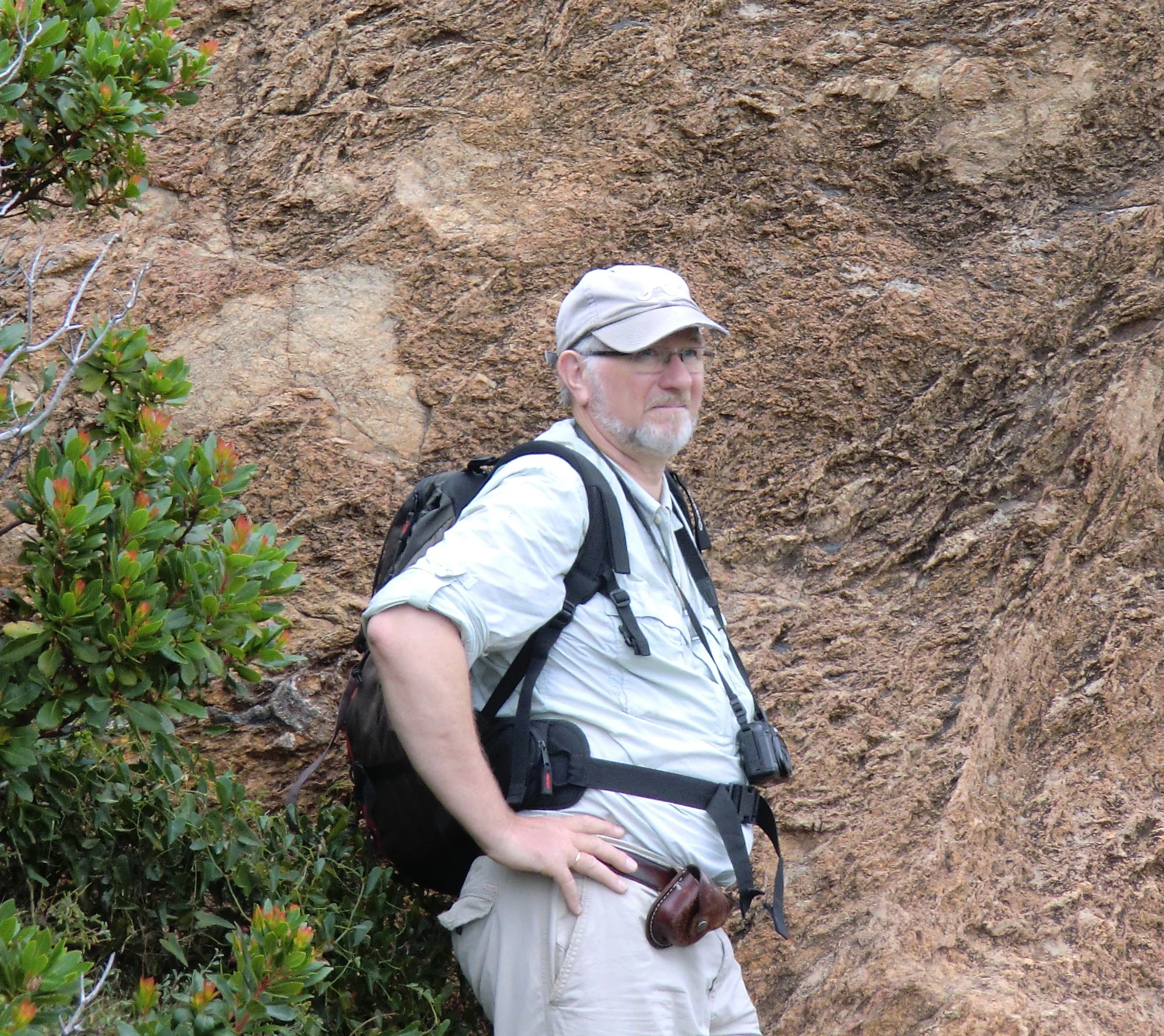
Along the coast of western Norway and far inland, pods of eclogite scattered through grey gneiss contain tiny inclusions of coesite, a dense form of quartz that can form only at pressures found about 100 km below the surface. In the podcast, Torgeir Andersen explains how coesite was discovered, how these rocks were pulled down to such depths some 400 million years ago when Baltica collided with Laurentia, and how they then returned to the surface. He also discusses why a few isolated diamond-bearing pods may record local overpressure rather than greater depth.
Andersen has studied the rocks of Norway's Western Gneiss Region for several decades. He is Professor Emeritus of Geology at the University of Oslo.
Podcast Illustrations
Courtesy of Torgeir Andersen unless otherwise indicated.
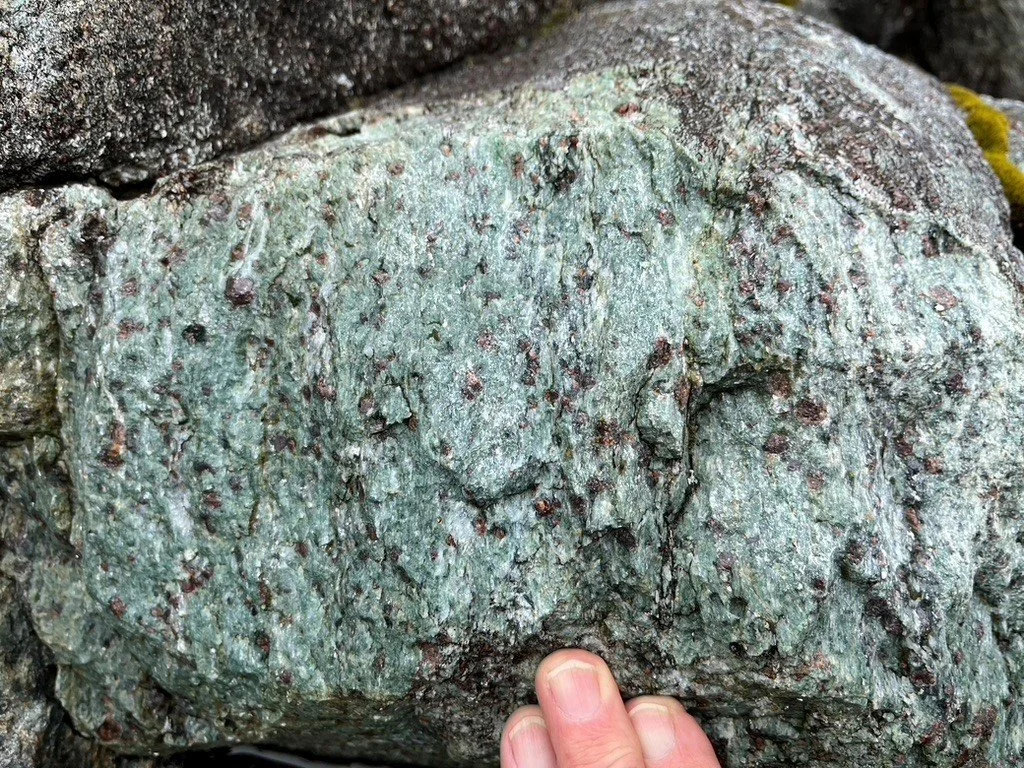
Eclogite in Vårdalsneset, in the Western Gneiss Region of Norway. In the Western Gneiss Region of Norway, eclogite occurs in pods within the prevailing grey granitic gneiss. The pale green matrix is omphacite, a sodium-rich pyroxene, studded with dark red garnets. The rock began as a gabbro or dolerite intruded into Baltican continental crust long before the Caledonian orogeny, and was converted to eclogite when that crust was dragged to great depth. As Andersen explains in the podcast, eclogite is denser than the mantle; its "life belt" is the lighter granitic gneiss that encloses it.

Geological map of the Western Gneiss Region, which extends for about 600 km up the coast and inland from Bergen. The pink areas (labeled Baltican basement) are Baltica's own ancient crust — gneisses roughly a billion years old or older, containing the eclogite pods discussed in the podcast. This crust was subducted as a whole beneath Laurentia, to depths increasing westward. The three ultrahigh-pressure domains along the outer coast, where coesite and, in places, diamond have been found, mark the part that went deepest — the high end of the metamorphic gradient that Torgeir Andersen describes. The deep rocks were brought back up beneath extensional detachments such as the Nordfjord–Sogn Detachment. Devonian basins such as Hornelen and Kvamshesten (brown) formed in the hanging wall of the detachment, filling with sand and gravel as the rocks beneath them rose. The green areas are great sheets of rock thrust eastward over Baltica during the collision, made up of slices of Baltica's outer margin and of Iapetus ocean floor and island arcs. The lower sheets, which lay on the leading edge of Baltica, were subducted along with the gneisses beneath them; the higher ones, such as those the Devonian basins rest on, never went deep. Laurentia itself is now East Greenland, across the Atlantic.
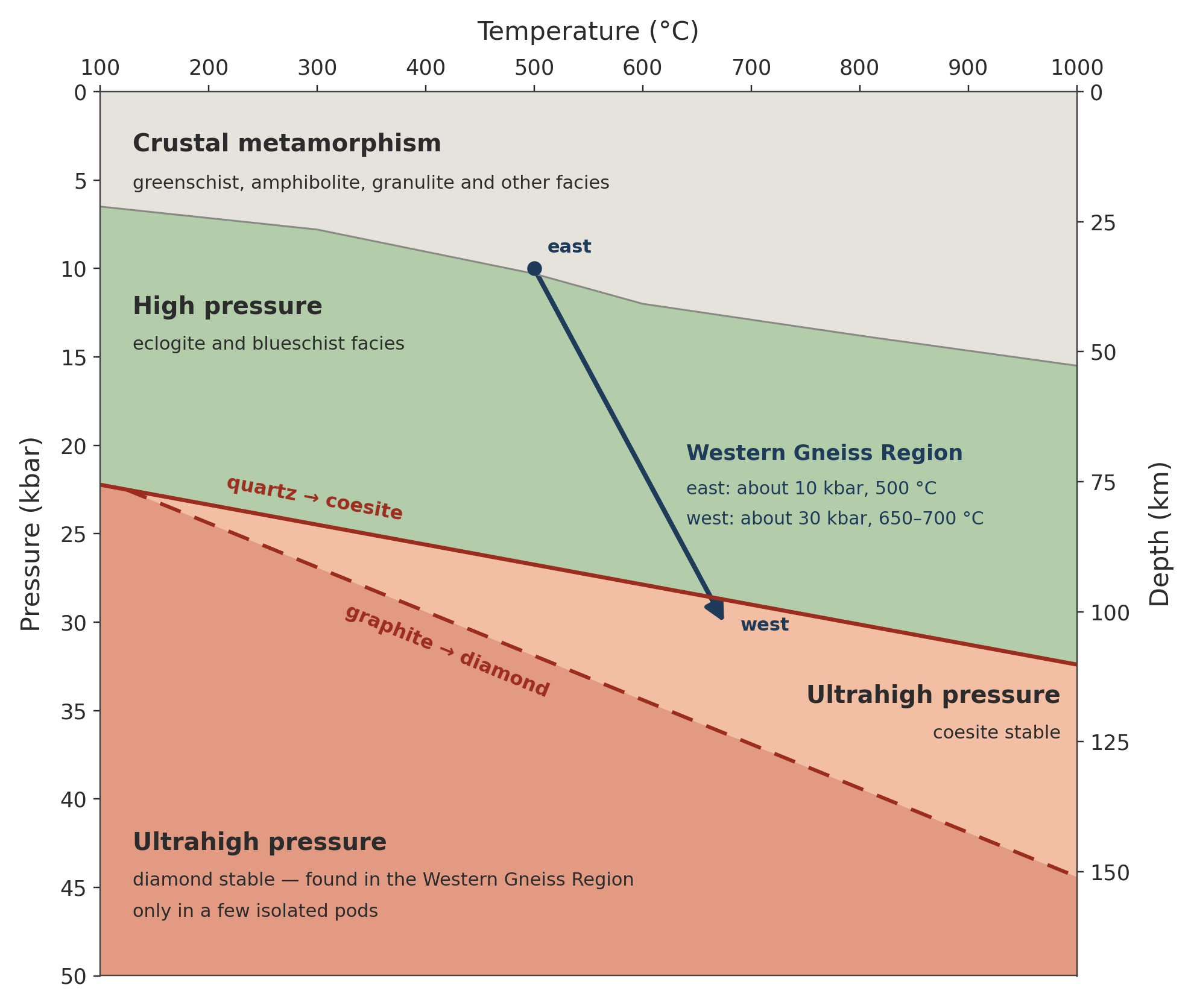
Pressure and temperature conditions of metamorphism, from the crust down to the depths discussed in the podcast. Pressure is shown in kilobars, the unit Andersen uses: one kilobar is roughly 1,000 atmospheres, and 10 kilobars equal one gigapascal (GPa), the unit now standard in the scientific literature. The labels name metamorphic facies, which are sets of minerals that form together within a particular range of pressure and temperature. Eclogite, the high-pressure facies, forms from about 40–50 km down. Ultrahigh-pressure metamorphism begins where quartz turns into coesite, at about 27–32 kbar depending on temperature, roughly 90–110 km down. Deeper still, graphite turns into diamond. Eclogite's garnet and omphacite remain stable at these pressures, which is why, as Andersen explains in the podcast, eclogite alone doesn't prove ultrahigh pressure: that takes coesite or diamond. The arrow shows the gradient across the Western Gneiss Region that he describes, from about 10 kbar and 500 °C in the east to about 30 kbar and 650–700 °C in the west, just across the coesite line. The depth scale assumes that pressure comes from the weight of the overlying rock — an assumption that, as discussed at the end of the podcast, may break down locally.
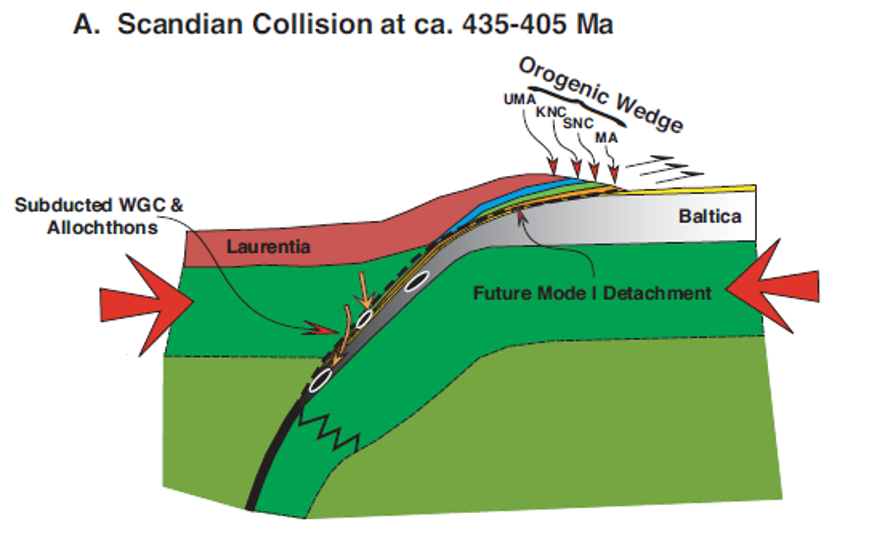
(A) During the Scandian collision — the final phase of the Caledonian orogeny, when Baltica itself collided with Laurentia — about 435–405 million years ago, the leading edge of Baltica — the Western Gneiss Complex (WGC), shown in pink on the map above, together with the rock sheets already stacked on it — was dragged westward beneath Laurentia by the sinking plate it was attached to. Higher rock sheets were thrust eastward over Baltica, building the wedge labeled at the top. The dashed line marks the surface along which the buried rocks, in its footwall, would later return, sliding up past the hanging wall above.
Brueckner, H.K. et al. (2013), Lithosphere, doi: 10.1130/L256.1
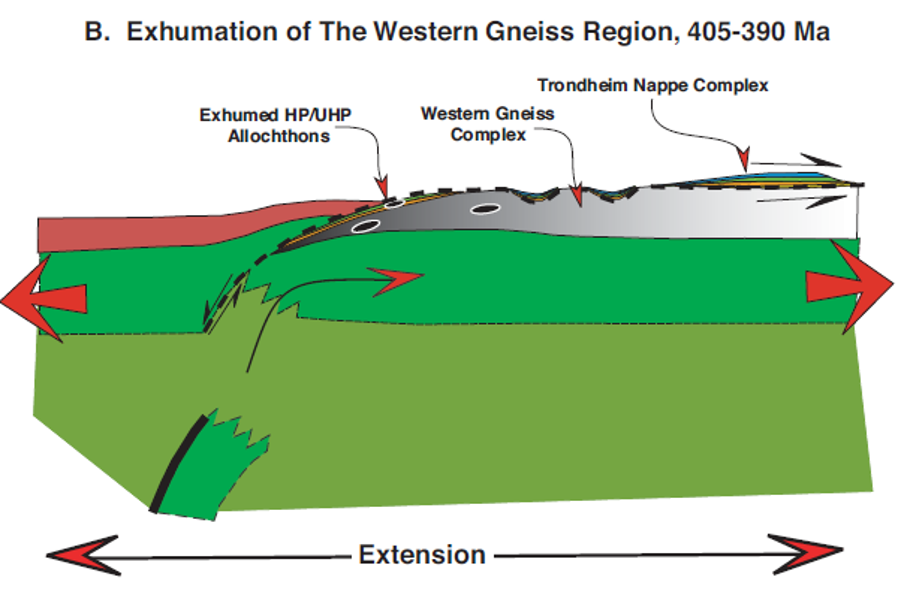
(B) By about 405 million years ago, the descending slab had broken off. As Andersen explains in the podcast, once released from its heavy anchor, the buoyant continental crust rose back along the former subduction zone, while the whole mountain belt stretched and collapsed, bringing the ultrahigh-pressure rocks up to shallow depths. Note that green here is the mantle, not the rock sheets shown in green on the map above.
Physics-based computer simulation of the subduction, slab break-off, and exhumation described in the podcast. Grey is continental crust; green is ocean crust; blue is the cold, rigid upper mantle; and purple is the hotter, weaker mantle beneath. The model starts with the initiation of subduction of oceanic crust under the continent to the right. About 5.2 million years into the simulation, the leading edge of the continent at the left reaches the trench and is dragged down by the dense oceanic slab. Just before 19 million years, the sinking slab breaks off, and, as Andersen describes in the podcast, the buoyant continental crust reverses direction and rises back toward the surface. In Norway's case, the continent on the left would be Baltica, so the picture is the mirror image of the diagrams above.
Duretz, T. et al. (2012), Journal of Geophysical Research: Solid Earth 117, B08411
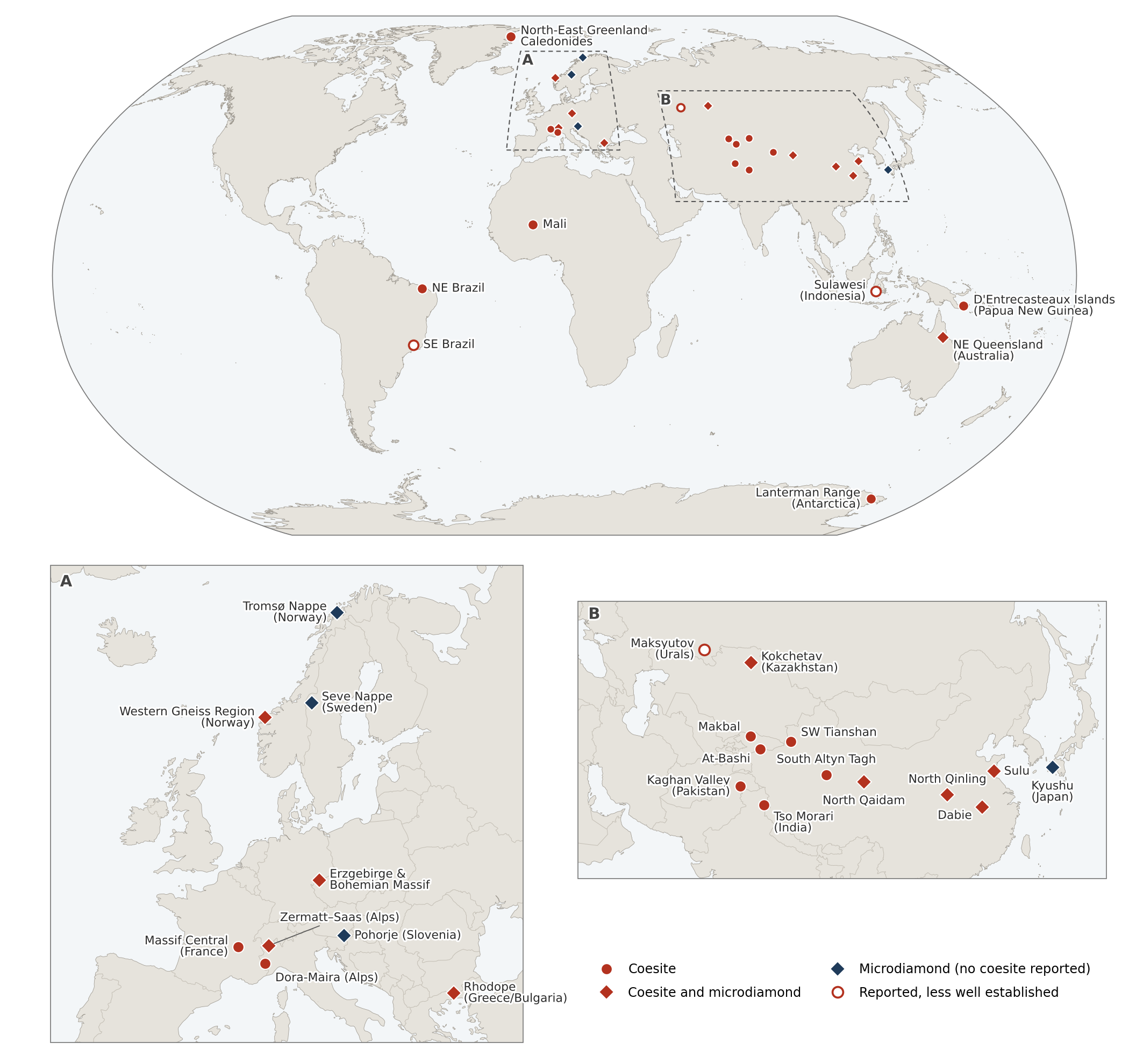
Ultrahigh-pressure metamorphic rocks around the world. All were formed by subduction zones, and most lie in mountain belts built by continental collision, such as the Caledonides, the Alps, and the Himalaya. Most formed within the last 540 million years or so. The oldest, in Brazil and Mali, are about 650–620 million years old; the youngest, in the D'Entrecasteaux Islands of Papua New Guinea, described in the podcast, are less than 10 million years old.
Compiled from:
Liou, J.G. et al. (2004), International Geology Review, 46, 1
Liou, J.G. et al. (2009), Journal of Asian Earth Sciences, 35, 199
Warren, C.J. (2013), Solid Earth, 4, 75, and subsequent reports